



 Back to Press Release
RNAi as a Therapeutic Exemplar: Mechanism, Clinical Progress, and Multifaceted Potential of STP705
1.What is STP705, and how does its PNP-based extrahepatic delivery work?
STP705 is a proprietary siRNA-based therapeutic candidate developed by Sirnaomics for the treatment of multiple indications. It consists of two small interfering RNAs (siRNAs) targeting transforming growth factor beta 1 (TGF-β1) and cyclooxygenase-2 (COX-2), respectively. These siRNAs are formulated using Sirnaomics’ proprietary peptide nanoparticle (PNP) delivery system.
The STP705 formulation forms nanoparticles with a uniform nanoscale size, positive zeta potential, and robust physical stability (Figure 1). Notably, STP705 demonstrates excellent storage stability at 5 °C, supporting an extended shelf life of ≥24 months at 2–8 °C without the need for chemical modification of the siRNA payload. This formulation strategy preserves the native structure of siRNA while ensuring efficient delivery and biological activity.
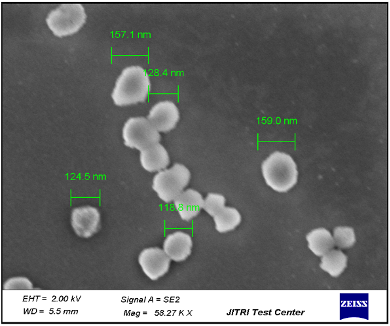
Figure 1. Scanning Electron Microscope (SEM) image of STP705 nanoparticles.
2.Analysis of an Extrahepatic Delivery System with Excellent Biocompatibility and Low Immunogenicity: PNP and the Key Excipient HKP
The delivery of siRNA remains a central challenge in RNA therapeutics. Sirnaomics’ polypeptide nanoparticle (PNP) platform was specifically designed to address this challenge by balancing delivery efficiency, safety, and manufacturability.
PNP is composed exclusively of siRNA and a single functional excipient, histidine-lysine polypeptide (HKP). HKP features a unique branched molecular architecture (Figure 2). Importantly, HKP is composed of only two natural amino acids—histidine and lysine—which contributes to its favorable biocompatibility and low immunogenicity.
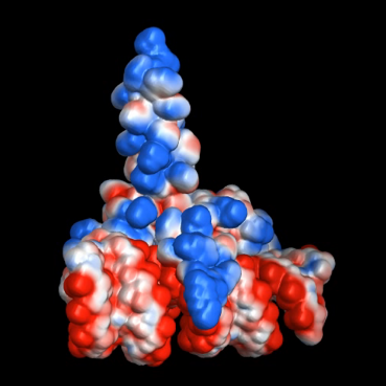
Figure 2. Electrostatic surface representation of HKP bound to an siRNA duplex. Blue: positive potential; red: negative potential.
Key characteristics of the PNP delivery system include:
- Efficient siRNA delivery in multiple preclinical models
- Favorable safety profile, with good tolerability observed in animal studies
- Low immunogenicity, supported by both structural simplicity and biological data
Structurally, PNP differs fundamentally from conventional lipid nanoparticles (LNPs). Unlike the micellar architecture of LNPs, PNP forms an unlayered, solid spherical structure. PNP nanoparticles are pH-sensitive, allowing them to respond dynamically to the acidic environment of endosomes.
Mechanistically, PNP interacts with the cell membrane more readily than many lipid-based systems and facilitates endosomal escape via the proton sponge effect, driven by the histidine residues in HKP. This enables efficient cytoplasmic release of siRNA without relying on membrane-disruptive lipids.
3.Delivery Principles of PNP and Mechanism of Action of STP705
The therapeutic activity of STP705 arises from both gene-specific silencing effects and formulation-associated biological properties.
First, STP705 simultaneously inhibits TGF-β1 and COX-2, two key signaling molecules involved in a wide range of pathological processes. TGF-β1 plays a critical role in tumor progression, fibrosis, immune suppression, and adipose tissue remodeling, while COX-2 is a central mediator of inflammation, angiogenesis, and tumorigenesis. Dual inhibition of these targets allows STP705 to modulate multiple disease-relevant pathways in a coordinated manner.
Second, while PNP exhibits transient, localized membrane interaction to facilitate uptake, this effect is quantitatively and qualitatively distinct from cytolytic agents (e.g., deoxycholic acid), resulting in controlled tissue remodeling without uncontrolled necrosis or excessive inflammation. Instead, it may contribute to localized biological effects that complement siRNA-mediated gene silencing.
STP705 has been explored across multiple dermatological and localized indications, where localized administration allows precise dose control. Clinical studies have demonstrated robust efficacy in non-melanoma skin cancer (NMSC), as well as localized fat reduction, highlighting its indication-specific therapeutic profile.
4.Delivery to Skin Tissue: Clinical Data in Non-Melanoma Skin Cancer (NMSC)
In clinical studies involving patients with non-melanoma skin cancer, intralesional administration of STP705 has demonstrated encouraging antitumor activity. In a Phase II clinical trial (NCT04293679) involving patients with cutaneous squamous cell carcinoma in situ (isSCC), intralesional administration of STP705 demonstrated promising antitumor activity, with 76% of subjects (19/25) achieving complete histological clearance. These results align mechanistically with STP705’s dual RNAi-mediated suppression of TGF-β1 and COX-2, key drivers of tumor proliferation, immunosuppression, and inflammatory microenvironment remodeling in cutaneous malignancies.
STP705 has shown a favorable safety and tolerability profile in these studies, with adverse events primarily limited to mild or moderate local injection-site reactions. The observed clinical responses support further late-stage clinical development in this indication.
5.Adipose Tissue Targeting: Clinical Progress in Local Fat Reduction
In a Phase I clinical trial (NCT05422378), STP705 demonstrated localized fat reduction efficacy mediated by targeted modulation of inflammatory signaling and adipose tissue remodeling pathways. Localized, transient inflammatory responses—including focal adipocyte necrosis—were confined to the injection site, with subsequent tissue resolution and preserved dermal integrity. Critically, no systemic exposure or treatment-related safety signals were observed. The favorable tolerability profile of PNP further contributed to a low incidence of local skin reactions (LSRs), demonstrating an excellent safety profile in this study.
This dose-dependent divergence in clinical outcomes underscores the flexibility of STP705 as a locally administered RNA therapeutic and highlights the importance of delivery system–target interaction in shaping biological effects.
6.Perspective
The PNP delivery system represents a structurally and functionally complex therapeutic platform, in which multiple components and mechanisms contribute to overall efficacy and safety profile.
Leveraging over 15 years of platform refinement and clinical validation across multiple trials, Sirnaomics has established a comprehensive profile of the PNP system. STP705 is now advancing toward global Phase III development for isSCC, with parallel Phase II planning for localized adipose remodeling.
Together, these efforts position STP705 as a leading example of how rationally designed siRNA therapeutics and innovative delivery systems can enable multi-indication clinical development from a single molecular platform.
About Sirnaomics
Sirnaomics Ltd.(HK: 2257), known as Asia's "First RNAi Therapeutics Stock," is a clinical-stage global biopharmaceutical company specializing in RNA interference technology. Utilizing its dual core technology platforms and diverse pipeline, the company is at the forefront of developing RNAi therapies to drive industry growth.
Sirnaomics has two proprietary delivery platforms:
- Polypeptide Nanoparticle (PNP) Platform: An extrahepatic delivery platform enabling precise targeting of tissues such as skin, adipose tissue, and muscle.
- GalAhead™ Delivery Platform: A liver-targeted delivery system with clear IP and long-acting administration capabilities.
The company is also an industry leader with its innovative linker-free, dual-target RNAi technology. Sirnaomics' robust pipeline addresses oncology, local fat reduction, medical aesthetics, and cardiovascular diseases, with multiple products in clinical trials. Beyond its internal development, Sirnaomics embraces an open-collaboration strategy, integrating its technology platforms to support the broader industry and benefit patients worldwide.

 Previous
