



 Back to Press Release
Major Review | Polypeptide Nanoparticles (PNP) Emerge as a New Choice for RNA Drug Delivery
The paper Polypeptide nanoparticles: a clinically validated, versatile delivery platform for RNA therapeutics was published in Nucleic Acid Insights in June 2026. Authored by the R&D team at Sirnaomics, the review systematically dissects the PNP delivery system built upon histidine-lysine polypeptide (HKP) and directly addresses the core bottlenecks of RNA therapeutic translation: poor nucleic acid stability, inefficient cellular uptake, and the formidable challenge of targeting extrahepatic tissues or crossing the blood–brain barrier.
I. Hitting the Pain Points: How PNP Solves the “Impossible Triangle” of RNA Delivery
Although RNA therapeutics (siRNA, mRNA) are hailed as the “holy grail” of precision medicine, their clinical translation has long been hampered by three major barriers: poor nucleic acid stability, difficult cellular uptake, and an inability to effectively target extrahepatic tissues or breach the blood–brain barrier.
Sirnaomics’ PNP technology, with its unique histidine-lysine polypeptide (HKP) architecture, provides an innovative solution:
- Novel mechanism, highly efficient escape: PNP exploits the “proton sponge effect” of histidine residues—upon endosomal acidification, the polymer absorbs water, swells, and ruptures the endosome, enabling highly efficient release of the RNA cargo. This mechanism avoids the high toxicity typical of conventional cationic polymers while achieving an endosomal escape efficiency of up to 30%–50%, comparable to that of lipid nanoparticles (LNPs).
- Dual-cargo capability, flexible and versatile: Unlike GalNAc conjugates, which are restricted to siRNA, PNP can simultaneously carry both siRNA and mRNA. Unlike LNPs, which must rely on hepatic accumulation, PNP excels at local retention, making it an ideal fit for applications in the skin, adipose tissue, muscle, eye, and solid tumors.
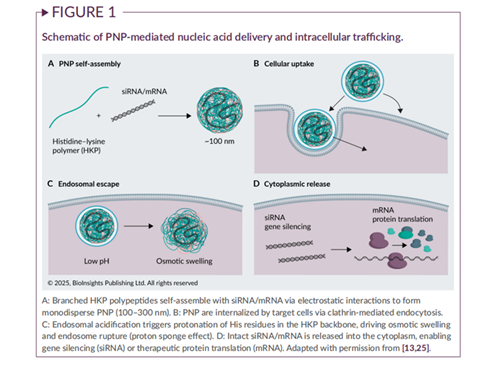
Figure caption: Structural design of PNP and the endosomal escape mechanism (proton sponge effect).
The image illustrates how HKP polypeptides selfassemble with siRNA/mRNA and, upon endosomal acidification, rupture the endosome via osmotic pressure to release the therapeutic cargo.
II. Clinical Validation: A Robust Stride from Bench to Bedside
Unlike most delivery technologies that remain in exploratory phases, the PNP platform has already accumulated substantial clinical data. The review highlights the delivery performance of Sirnaomics’ core product, STP705 (a dual-target siRNA), in human tissues:
- Cutaneous squamous cell carcinoma (isSCC): In Phase IIa and IIb clinical trials, STP705 demonstrated outstanding efficacy and safety. Phase IIb data showed a complete histological clearance (CHC) rate as high as 88.9%, with no serious adverse events and excellent local tolerability.
- Localized fat reduction (aesthetic & metabolic): The first-in-human clinical trial (NCT05422378) confirmed that PNP can effectively deliver siRNA into subcutaneous adipose tissue, achieving targeted adipocyte destruction and tissue remodeling without the risk of fibrosis.
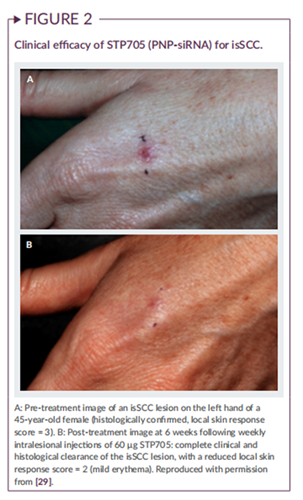
Figure caption: Clinical efficacy of STP705 in treating cutaneous squamous cell carcinoma (isSCC).
The image visually demonstrates marked lesion clearance and the skin restoration process following PNP-siRNA treatment.
III. Differentiated Complementarity: The “Big Three” Landscape of PNP, LNPs, and GalNAc
Through detailed comparison, the review points out that PNP is not intended to replace LNPs or GalNAc, but rather to form a perfect tripartite, complementary coexistence with these platforms, collectively covering the full spectrum of human disease.
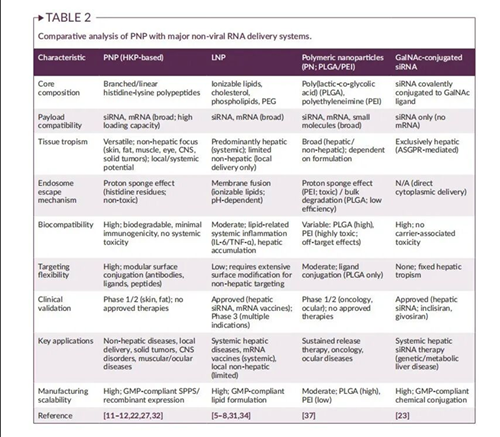
Figure caption: Comprehensive comparison of PNP, LNPs, GalNAc, and polymeric nanoparticles.
The data clearly demonstrate that LNPs dominate systemic/liver delivery, GalNAc specializes in hepatocytespecific targeting, and PNP seizes the absolute initiative in the extrahepatic, local, and minimally invasive CNS arenas.
Conclusion:
This review published in Nucleic Acid Insights is not only an authoritative recognition of the scientific value of PNP technology, but also a conspicuous emblem of Sirnaomics showcasing its strength to the global innovative drug industry. Moving forward, Sirnaomics will continue to delve deeply into the RNAi field, harnessing its proprietary delivery technology to benefit more patients worldwide.
For the full text of this review published in Nucleic Acid Insights,
please contact our Investor Relations Department.
Contact: Kay Wang
Email: [email protected]

 Previous
